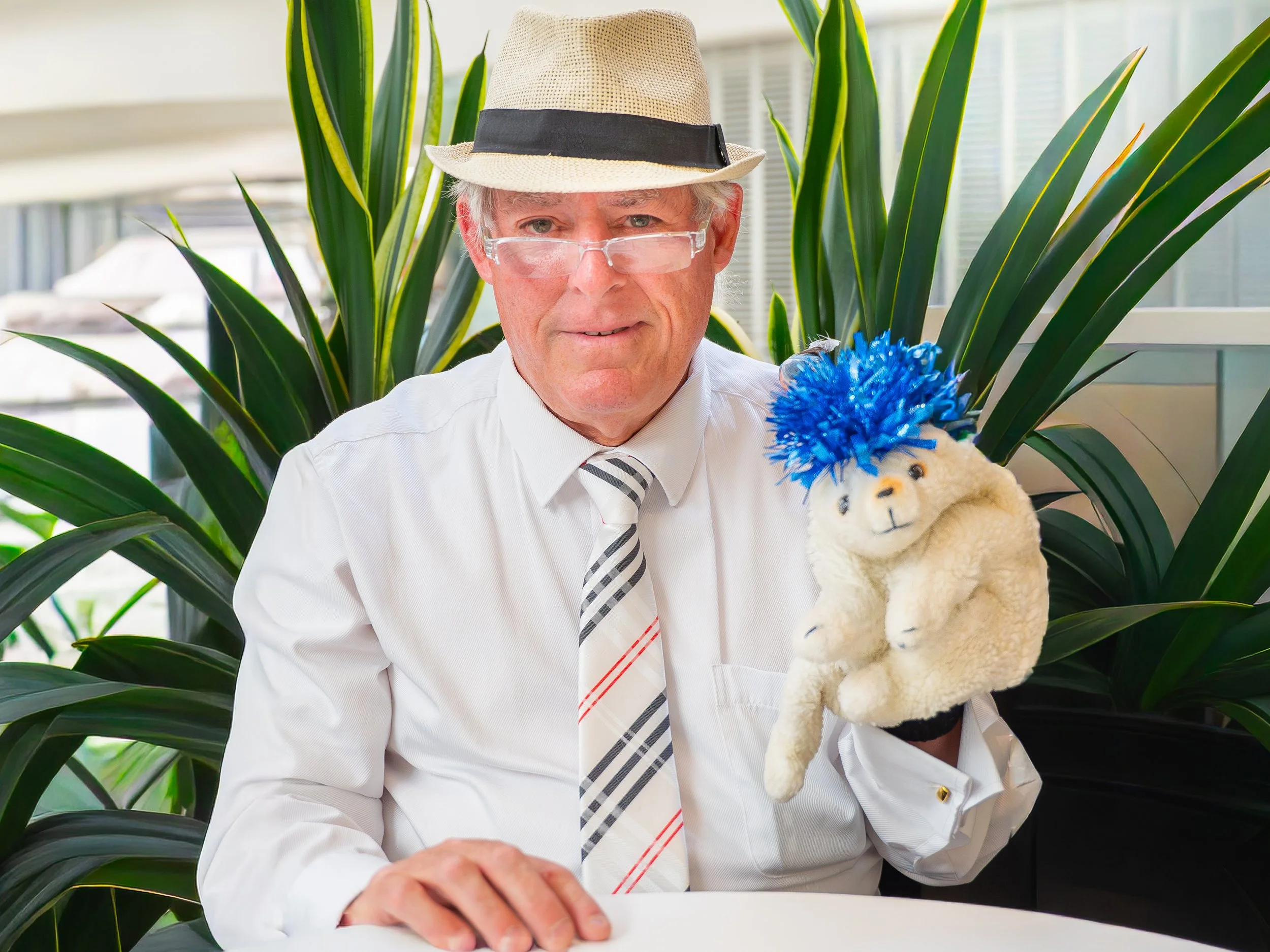
The man who makes Sarnia smile
If you've spent time driving through Sarnia, chances are you've seen them.
Perhaps you've noticed a colourful spinning umbrella dancing in the breeze. Maybe you've seen a puppet swaying to music while motorists wave from their vehicles, smile through open windows, or sound their horns in appreciation. As traffic passes by, people who moments before seemed lost in the concerns of daily life suddenly find themselves laughing, smiling, or simply paying attention to something unexpected and joyful.
That is exactly why George Thomas and George the Puppet are there.
They perform for one simple reason: to make people smile.
And if you've ever watched them for more than a few minutes, you'll quickly discover that they succeed.
Children stare in wonder. Adults slow down and grin. Some wave enthusiastically. Others return day after day just to see what George and his puppet companion are up to.
Together, they have become one of Sarnia's most unique and heartwarming sights.
But behind the spinning umbrella and the cheerful performances is a man whose life story is every bit as fascinating as the entertainment he provides.
After graduating from high school, George dedicated twenty years of his life to volunteer community service in Guelph. During those years he worked with people facing significant challenges and disadvantages. His commitment to helping others became a defining part of his life, and at one point he even put on a show for the Cystic Fibrosis Foundation.
Looking back on those years, George believes the experience changed him in ways he never expected.
"I learned more in my time working with people who had different disadvantages than I had."
It is a simple statement, but one that reveals a great deal about George's outlook on life. Rather than viewing community service as something he gave, he sees it as something that enriched him. The people he met taught him lessons about resilience, compassion, and humanity that stayed with him long after those twenty years came to an end.
Eventually, however, George realized he needed a different path.
With a laugh, he remembers the reality of working in community service.
"When I was 40, I didn't have any money, but that comes with the job. I thought I had better make some money and eventually found my way in the auto industry. I made very good money at piecework and was able to make enough money that when I was 55 I decided that was my last day."
For many people, retirement is a time to slow down and enjoy a quieter pace of life.
For George, it was the beginning of a new adventure.
Having always enjoyed music and performance, he decided to travel throughout Ontario, sharing his talents wherever he went. Since 2009, he has performed in twenty-two cities across the province.
Sarnia is one of those cities.
In fact, this is his second visit here.
The first time he came to Sarnia, he performed keyboard music at Germain Park. Back then there was no puppet. It was simply George and his music.
Today, things look very different.
George the Puppet has become an inseparable part of the performance, and George himself is still amazed by the reaction the puppet receives.
Life, however, almost took a very different turn.
In 2015, George collapsed in his driveway.
People gathered around him and attempted to find a pulse but were unable to do so.
What happened next remains one of the most remarkable moments of his life.
"Interestingly enough, there was a fella across the street that I had never met before, came to his window at that moment and saw a crowd of people across the street and somehow sensed there was a problem. He came running over and pushed through the crowd and the next thing I remember was in the hospital. This fellah was an EMS person. I didn't get a chance to thank him. I would like to thank him for that because if that hadn't happened then this man and George wouldn't be performing."
As George tells the story, it becomes clear that gratitude is something he carries with him every day. A stranger's willingness to act in a moment of crisis gave him more years of life, more opportunities to create, and more chances to make people smile.
Those additional years have allowed George to pursue another creative passion as well.
He is an author who writes under the name Edward J. Janzen.
"I started to write novellas and short stories based on people and places that I have lived in. Every one of those places on my journey has a story. Even my first trip to Sarnia has a story."
It's easy to understand why George enjoys storytelling. His own life has been filled with unique experiences, unexpected encounters, and memorable characters.
Perhaps that is also part of the reason he appreciates the puppet so much.
The puppet entered the spotlight almost by accident.
While performing in Hamilton, George noticed that audiences seemed particularly drawn to his puppet companion.
"I said OK, I'll just leave the keyboard in Hamilton and I'll take the puppet. I didn't think he would become this popular. He is a star."
When people suggest that George is the star, he quickly corrects them.
"Some told me that I am a star to which I said no it's not the same out there in the street because if I'm performing and I'm showcasing the puppet then I can perform with him."
The affection George has for the puppet is obvious. Rather than seeing it as a prop, he treats it almost like a performing partner. Together they create something playful and unexpected that captures people's imaginations.
heir performances are not limited to street corners.
Twice each week, George and George the Puppet visit the hospital.
There, away from the traffic and passing vehicles, they bring moments of joy to people who may be experiencing some of the most difficult days of their lives.
George recalls one interaction that left a lasting impression on him.
"I had a woman at the hospital talk to me and she said that my dad had been very sick and I have been very worried about him and you came in one day and that was the only time I smiled that day."
For George, comments like that reinforce the value of what he does.
"People have a lot going on in their lives right now and this is the distraction that they need."
There is wisdom in that observation.
Life can be heavy. People carry worries about family, health, finances, work, and countless other challenges. Sometimes what they need most is not a solution, but simply a moment to breathe, smile, and remember that joy still exists.
Perhaps nowhere is that more evident than in the reaction of children.
When I met with George, one of George the Puppet's biggest fans was nearby.
Four-year-old Sawyer Gardiner came with her father, Adam, and her brother Phinley. George explained that whenever he walks past the Gardiner home on his way to perform, Sawyer races to the front window.
She waves frantically and greets the pair with an enormous smile.
There is something beautiful about that image.
A child watching from a window, excited to see a puppet walk by.
A performer who takes time to wave back.
A simple connection that brightens both of their days.
In many ways, that interaction captures the essence of George Thomas and George the Puppet.
They are not selling anything.
They are not seeking fame.
They are not asking for recognition.
Instead, they offer something that has become increasingly rare: simple kindness.
In a world where people often hurry past one another without making eye contact, George and his puppet invite people to pause. To smile at a stranger. To wave. To laugh. To remember the childlike wonder that still exists beneath the responsibilities and worries of adulthood.
Over the past several months, George Thomas and George the Puppet have become one of Sarnia's most magical sights. They transform ordinary street corners into places of imagination and connection. They bring comfort to hospital patients, delight to children, and unexpected happiness to people simply driving home from work.
Their performances may last only a few moments, but the smiles they create often last much longer.
And perhaps that is their greatest gift to Sarnia.
Through music, movement, imagination, and kindness, George Thomas and George the Puppet remind us that joy can still be found in the simplest places. They have become a gentle and magical presence within our community—two unlikely friends spreading happiness with one smile, one wave, and one moment of wonder at a time.
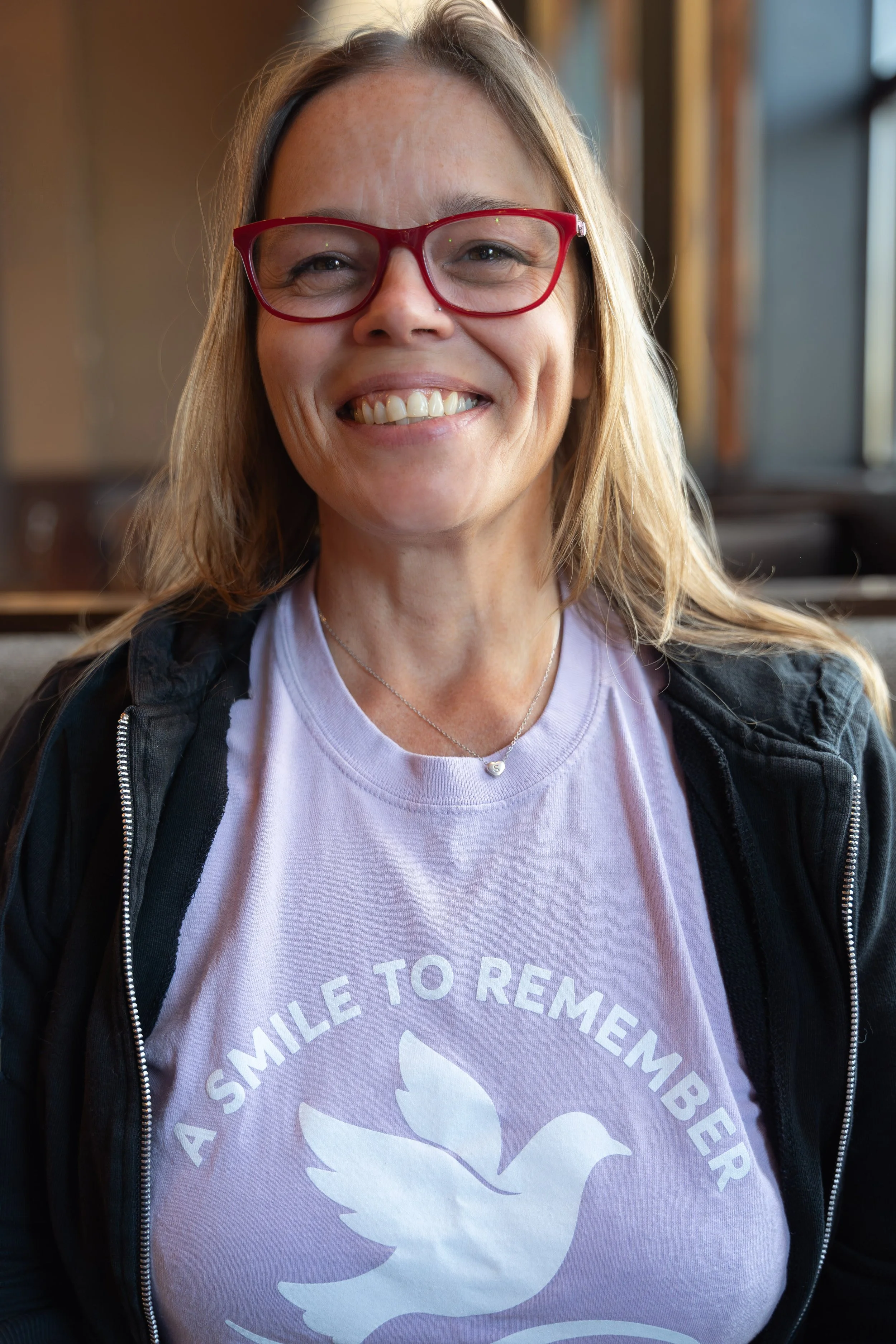
A smile to remember: How Lambton paramedics are granting final wishes
For the past 24 years, Sherry Tupholme has served the residents of Lambton County as a paramedic. She has responded to emergencies, comforted families during difficult moments, and dedicated her career to helping others. But some of her most meaningful work happens outside of her regular shifts through an organization she helped build called A Smile to Remember.
A Smile to Remember is a volunteer, paramedic-based organization that grants palliative patients one final outing of their choice in Sarnia-Lambton. Patients are often referred through the palliative care team at Bluewater Health.
"If the patient is in palliative care, whether it be in hospital or hospice, the nurses all know about our program and if it is a good fit they will tell the family," Sherry explains. "It must be the patient's wish and not the family's."
The program is designed for patients who are unable to sit in a regular vehicle or who require specialized medications, monitoring, or equipment that would otherwise make an outing impossible.
The idea was first introduced in 2019 when fellow paramedic Steve Adlington approached his colleagues with a vision of helping palliative patients experience one final meaningful moment outside of a healthcare setting. A call-out was sent to Lambton County for paramedics to gauge interest.
Sherry immediately saw the potential.
"I jumped right on it," she recalls.
Her role was to research how the program could operate. What she discovered surprised her.
"I reached out to a bunch of different Wish programs and discovered that there were no paramedic-based programs in North America. I reached out to a whole bunch of other Wish programs to see how their programs ran and from there I took their best ideas and kind of pieced it together."
The original model involved volunteers meeting patients and families ahead of time to create familiarity before the wish day arrived. Then COVID changed everything. Face-to-face introductions were no longer possible, forcing volunteers to adapt while continuing to serve patients safely.
When the program launched, organizers posted a sign-up sheet for volunteers.
The response was overwhelming.
That first call attracted 60 paramedics willing to donate their personal time to help fulfill wishes.
Today, when a request comes in, a mass text is sent to employees seeking volunteers. One important requirement remains unchanged: volunteers must be employees of Lambton County Paramedic Services.
"We've had a lot of people reach out like nurses and PSWs," Sherry says. "But unfortunately, we've had to turn them down because of insurance purposes and liability."
The wishes themselves range from large community events to simple family moments.
One story from the pandemic remains especially memorable.
"It was a gentleman who was diagnosed with terminal cancer, and he wanted to go home for his birthday."
What followed was something nobody expected.
"There ended up being a parade of 200 cars that went by his house wishing him a happy birthday."
The impact of that day still resonates. When Sherry meets newly hired paramedics during orientation, she often shares a video from that wish as a way of explaining the program's purpose and the difference it can make.
Other wishes are quieter but no less meaningful.
"There are some big events and then there are some that are simply to be with family," she says. "One gentleman wanted to go home and just decorate a tree with his family one last time."
A common request reflects a unique Sarnia tradition.
"Fries under the bridge."
Sherry says local businesses have been incredibly supportive.
"Albert's/Susie's Ice Cream has been great. Whenever I walk in, they say, 'You're the wish lady!' And they always donate food and always give to the crew as well."
For the volunteers, every wish brings a mix of emotions.
"It's all for the feelings that you feel. You feel sad because you know that this is the last thing this person is going to do like this, but you feel proud that you are making this happen. You're happy because you're watching it happen."
The program's success has not gone unnoticed. Since A Smile to Remember began in Sarnia-Lambton, four other counties have adopted similar programs based on the model Sherry and her colleagues helped create.
Sherry's own path to becoming a paramedic wasn't straightforward.
As a single mother at age 25, she decided to return to school to build a better future. She enrolled in Medical Administration but quickly realized it wasn't for her.
"I was sitting in the classroom doing some transcription class or something. It was boring," she laughed. "I looked out the window and saw an ambulance screaming by with its lights and sirens and thought, I want to do that."
She enrolled at St. Clair College in Windsor, graduated, and began a career that has now spanned nearly a quarter century.
Listening to Sherry speak, it becomes clear that A Smile to Remember is about far more than transportation. It is about restoring dignity, creating memories, and giving patients one final opportunity to experience something meaningful on their own terms.
It is also a reminder of the remarkable people serving our community.
Most of us think of paramedics as the professionals who arrive during life's emergencies. We see the lights, hear the sirens, and trust that they will be there when we need them most. What we don't often see are the countless hours they volunteer outside of their shifts, giving up personal time with their own families to help complete strangers create one last cherished memory.
The paramedics behind A Smile to Remember receive no pay for these outings. They volunteer because they care. They volunteer because they understand that sometimes the greatest form of medicine isn't a treatment or procedure—it's helping someone spend one final afternoon with family, enjoy fries under the bridge, celebrate a birthday, or simply go home one last time.
Founded by Steve Adlington Jeff Brooks and Sherry Tupholme, A Smile to Remember began with a simple but powerful vision: helping palliative patients experience one final meaningful outing with dignity and compassion. Today, that vision continues through the dedication of program coordinators Sherry Tupholme, Amanda Klazinga, and Emily Frewin, along with the many paramedics who volunteer their time to make these special journeys possible. Thanks to their collective efforts, Lambton County has something truly remarkable to be proud of.
These are professionals who do far more than respond to emergencies. They go above and beyond, offering compassion when it is needed most and proving that even at the end of life, a simple wish can leave a lasting impact.
And for the families who receive that gift, it is truly a smile to remember.